Discover why Uber Freight operates differently from Uber Rides. Learn about the complexities of freight logistics, broker layers, and market challenges that make Uber Freight less seamless than traditional Uber.
Introduction
At first glance, Uber Freight might sound like a natural extension of Uber’s ride-sharing success; a digital platform that connects shippers with truck drivers just as Uber connects riders with drivers. However, despite the shared branding, the two operate in completely different worlds. While Uber revolutionized person-to-person urban transport, Uber Freight is embedded in a complex B2B logistics ecosystem full of intermediaries, regulations, and legacy systems.
Let’s explore why Uber Freight is not the same as Uber, the operational challenges it faces, and what key factors limit its ability to achieve the same level of disruption as its parent platform.
Understanding the Uber Model: One-to-One Simplicity
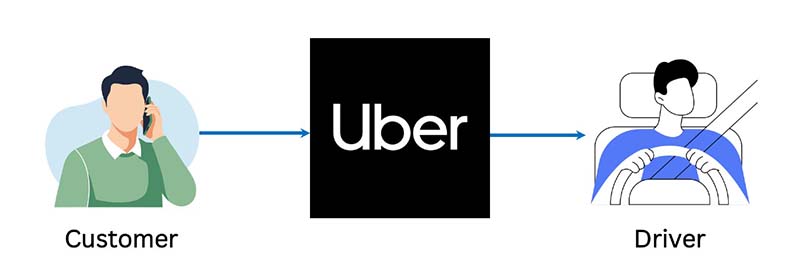
Uber’s ride-hailing model is built on simplicity and immediacy.
• A customer requests a ride.
• A driver accepts and completes the trip.
• The transaction settles instantly through the app.
It’s a one-to-one digital transaction, minimal friction, and high scalability.
The Uber Freight Model: A Web of Intermediaries
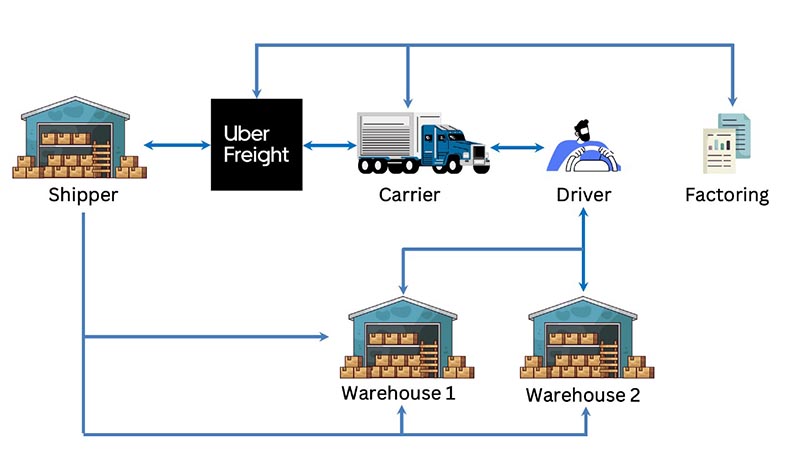
By contrast, Uber Freight operates in a multi-layered, business-to-business environment. Here’s how a typical load moves through the system:
1. A shipper requests a load on Uber Freight.
2. Uber (as broker) finds a carrier, often chosen based on price or availability.
3. The carrier communicates with a driver to execute the job.
4. After delivery, the driver submits proof of delivery (POD) to the carrier.
5. The carrier sends the paperwork to Uber.
6. Uber bills the shipper and waits for payment.
7. Once received, Uber pays the carrier or a factoring company if the invoice is financed.
Each layer introduces communication delays, manual paperwork, and settlement lags, unlike Uber’s instant digital transactions.
For comparison, see C.H. Robinson’s freight process at https://www.chrobinson.com.
The Communication Disconnect
Most carriers in freight still operate with manual workflows, often using phone calls, emails, or paper documentation. This analog dependency slows down the entire payment and tracking process.
Difference in Market Nature: B2C vs. B2B
Uber’s ride-sharing model thrives in the consumer market (B2C); high volume, low complexity, short transaction cycles. Uber Freight, however, operates in B2B logistics, a field already dominated by established broker powerhouses such as C.H. Robinson, J.B. Hunt:
Market Competition and Broker Powerhouses
Unlike taxi operators, freight brokers like C.H. Robinson and J.B. Hunt have nationwide networks, strong relationships, and robust systems, making disruption harder. These brokers also invest heavily in proprietary TMS platforms and digital visibility tools, creating competitive barriers to new entrants like Uber Freight.
Payment and Settlement Delays
In Uber rides, payments are instant. In Uber Freight:
• Shippers may take 30–90 days to pay invoices.
• Uber must then process, verify, and settle payments with carriers.
• If factoring companies are involved, payment routing becomes even more complicated.
According to FreightWaves analysis, most small carriers continue to face payment delays averaging 45 days across the industry.
Regulatory and Compliance Complexity
Freight movement involves DOT regulations, insurance requirements, driver hours-of-service limits, and cargo liability, all of which create barriers to automation. Learn more about these compliance measures at the U.S. Department of Transportation: https://www.transportation.gov.
Technology Adoption Barriers
Many small and mid-sized carriers lack digital adoption, using excel invoices and manual proof of deliveries. Uber’s app simplifies booking, but back-office workflows remain analog. This digital gap is one of the biggest reasons why Uber Freight’s vision of seamless automation remains unrealized.
Pricing Model Differences
Uber uses dynamic pricing; Uber Freight depends on market load-to-truck ratios, fuel costs, and contracts, not purely algorithmic pricing. This limits real-time responsiveness and prevents Uber Freight from achieving the efficiency of its parent platform.
The Human Relationship Factor
Freight logistics is relationship-driven. Shippers prefer brokers they trust, so Uber Freight is deploying human account managers and operations agents to maintain client relationships — a clear sign that technology alone cannot replace industry experience.
Data Integration Challenges
Freight systems rely on TMS, EDI, and manual updates. Uber Freight’s API-based model struggles to integrate across all legacy systems.
Scalability Constraints
Uber scaled easily with minimal driver onboarding. Freight carriers require insurance, licensing, and compliance, limiting scalability. These structural barriers restrict Uber Freight’s ability to expand at the pace its ride-share model achieved.
Market Profitability Pressure
Freight brokerage margins are typically low (10–15%). Uber Freight must absorb technology and support costs, squeezing profits. Competing with established brokers requires scale, operational efficiency, and trust, all of which take time to build.
Future Outlook for Uber Freight
Uber Freight is evolving with AI-based route optimization, digital factoring, and enterprise partnerships. Yet, complete Uberization remains distant. Industry experts from FreightWaves note that Uber Freight’s current growth trajectory resembles established broker trends rather than disruptive innovation: https://www.freightwaves.com.
Conclusion
Uber Freight set out to bring the transparency and simplicity of ride-sharing to logistics but ultimately became another digital broker. Rather than empowering the carriers who move freight, it focused on controlling transactions and digitizing traditional brokerage functions. While the platform improved efficiency and visibility, it failed to address the deeper structural challenges of trucking; fragmentation, low margins, and broker dependency. In the end, Uber Freight modernized freight brokerage’s appearance without transforming its core, remaining a participant in an old system rather than a true disruptor.