Uncover the hidden costs of freight brokers, explore why the system became broker-dependent, and discover how carriers can bridge the gap to regain control, profits, and trust in logistics.
Understanding the Freight Brokerage Model
The Original Purpose of Freight Brokers
Freight brokers were originally created to solve coordination problems in logistics. In a fragmented market, shippers needed loads moved quickly, and carriers needed consistent work. Brokers stepped in to connect both sides, offering efficiency and relationship management.
This model worked exceptionally well in the era of paper-based logistics.
Back then, the industry relied on manual processes, phone calls, faxed load sheets, and handwritten dispatch notes. Information moved slowly, and digital visibility didn’t exist. Brokers became the central coordinators who kept everything running, matching loads, scheduling pickups, and handling paperwork. Their value lay in managing complexity through human relationships and paper trails.
In the early days, this made perfect sense — brokers had industry knowledge, personal networks, and negotiation skills that most carriers couldn’t easily access. They added value by ensuring trucks didn’t run empty and goods were delivered on time.
How the Brokerage System Evolved
Over time, as freight volumes exploded and digital tools emerged, the broker’s role began to shift. What started as a helpful bridge slowly turned into a gatekeeping system. Brokers began controlling access to loads, pricing information, and shipper relationships.
Today, many carriers find themselves dependent on brokers not because they want to be, but because the system offers few alternatives. The result? A structure where carriers do the hard work while brokers control the flow of information, often one sided.
The Hidden Costs Carriers Face in Broker-Driven Logistics
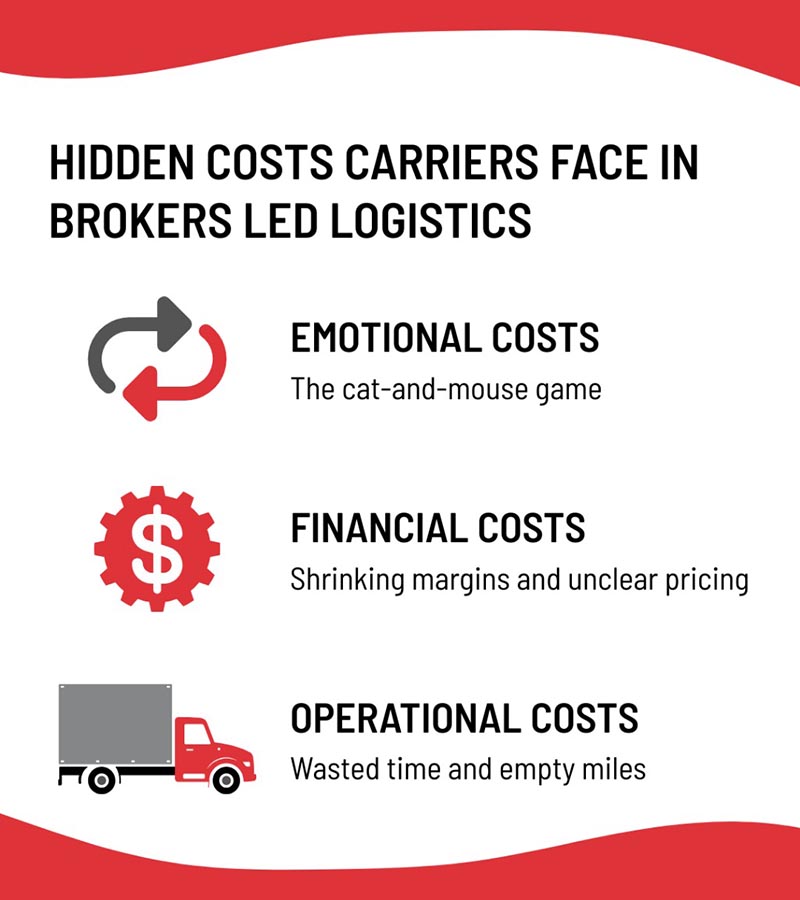
Emotional Costs: The Cat-and-Mouse Game
Beyond financial and operational challenges, carriers face another burden that is harder to measure but deeply felt: the emotional strain of working in a broker-driven system.
Every load often becomes a negotiation game where trust feels uncertain and information feels incomplete. Carriers spend valuable time chasing updates, confirming details, or renegotiating rates, always unsure if a better-paying or more efficient load is being kept off the table.
This constant cycle creates frustration and fatigue. It also discourages long-term relationship building because every transaction feels transactional rather than collaborative. Many carriers describe this experience as a daily cat-and-mouse game, where communication gaps and limited transparency lead to anxiety and inefficiency.
Over time, this lack of trust affects decision-making and morale. Drivers begin to focus more on short-term survival than on sustainable growth. The emotional toll of uncertainty becomes as costly as any financial loss, slowly eroding the stability and confidence that carriers need to run their operations effectively.
Financial Costs: Shrinking Margins & Unclear Pricing
At first glance, a broker’s cut may seem like a small percentage, a necessary fee for coordination. But the numbers tell another story. Many brokers take 10–30% of the total load value, which steadily erodes the carrier’s profit margin.
The problem runs deeper than just commission. Broker pricing often fails to reflect the real-world costs of running a truck.
Brokers typically quote rates based on what shippers are willing to pay, not on what it actually costs to move that load. They’re often disconnected from the ground realities of trucking — the rising costs of fuel, driver pay, insurance, maintenance, tolls, and equipment financing.
For carriers, these operating expenses can easily consume 80–90% of total revenue. When a broker’s margin is added on top of that, the math simply doesn’t work. Carriers are left operating on razor-thin margins, taking on the highest share of risk for the smallest slice of profit.
Even worse, most carriers have no visibility into what the shipper actually paid. Without transparency, they can’t assess whether a load is priced fairly, or if they’re absorbing costs the broker never accounted for.
This lack of alignment between real operational expenses and broker-driven pricing is one of the most damaging inefficiencies in the freight system today.
Operational Costs: Wasted Time and Empty Miles
Beyond money, there’s lost time; an invisible cost that carriers feel every single day, looking for loads, negotiating loads rather efficiently delivering. Brokers often prioritize loads that maximize their own commissions, not necessarily what fits the carrier’s preferred lanes, fuel efficiency, or backhaul needs.
This misalignment creates one of the industry’s biggest inefficiencies: deadheading, which means running empty trucks between loads.
Industry data shows that between 20% and 35% of total truck miles are non-revenue miles. These empty miles still consume fuel, driver pay, maintenance, and insurance costs, placing the financial burden squarely on the carrier.
What seems like a small scheduling gap quickly turns into wasted time, unnecessary fuel use, and reduced profitability. Over time, these inefficiencies make a significant impact on a carrier’s bottom line and overall productivity.
Why the Freight System Became Broker-Dependent
 The Data & Relationship Gap
So why do brokers still dominate despite all this? Because for years, data fragmentation prevented carriers and shippers from connecting directly.
Shippers lacked visibility into available trucks; carriers lacked access to real-time load opportunities. Brokers filled that void by maintaining exclusive relationships and centralized communication channels.
The Power Imbalance
This created an information asymmetry, brokers-controlled pricing, timing, and availability. Carriers, meanwhile, were left in the dark, forced to rely on brokers rather than transparent market data.
The longer this imbalance persisted, the more it reinforced itself, making it nearly impossible for carriers to operate independently.
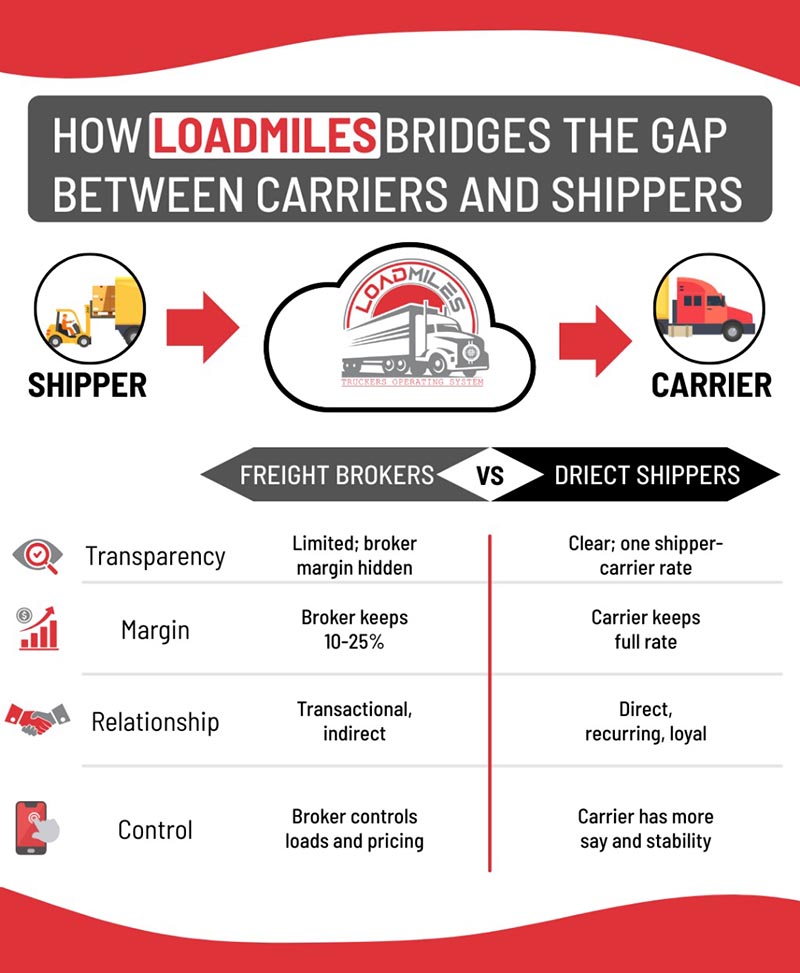
Freight Brokers vs Direct Shippers: What’s the Real Difference?
The contrast between these two models defines the next evolution of logistics.
Transparency and Negotiation: In the direct model, carriers finally see what shippers pay and negotiate on real data. This restores trust and balance, turning a one-sided game into a partnership.
Technology as the Enabler: Historically, direct access was impossible without the human broker. Today, technology platforms are bridging that gap, providing tools for carriers and shippers to connect in real time, negotiate rates, and manage loads efficiently.
The Ideal Freight Ecosystem: Direct, Transparent, Profitable
An ideal freight ecosystem doesn’t eliminate brokers out of hostility, it replaces manual middlemen with automated trust. A truly efficient network should offer data transparency, real-time communication, smart matching, and profit fairness.
How the Gap Can Finally Be Bridged
The solution isn’t about removing brokers overnight; it’s about redesigning how carriers and shippers connect. This requires tools that combine real-time visibility, automated matching, direct communication, and transparent pricing.
How LoadMiles Bridges the Gap Between Carriers and Shippers
LoadMiles matches carriers directly with shippers aligned to their route, capacity, and schedule. The carrier sets the price and owns the relationship, while LoadMiles runs the settlement and delivery platform behind the scenes. Carriers keep the trust; LoadMiles handles the paperwork, digital settlements, and real time visibility.
The Future of Freight: A Brokerless, Transparent Network
The future of logistics belongs to those who believe in open data, fair pricing, and direct relationships. As technology continues to empower carriers, the freight ecosystem is shifting toward brokerless, transparent, and data-driven operations.
FAQs
Q: Why can’t carriers and shippers just connect directly today?
Legacy systems and data fragmentation limit visibility, and most carriers function only as capacity providers without tools for end-to-end delivery management. Shippers also find it difficult to on-board and manage hundreds of individual carriers. Brokers fill this gap by offering unified communication, paperwork handling, and favorable credit terms.
Q: Are brokers still necessary for small carriers?
Sometimes. Many small carriers rely on brokers for access to loads, but modern digital networks now allow even the smallest fleets to connect directly with shippers.
Q: What is the biggest hidden cost of brokers?
Lack of transparency. Carriers rarely know what the shipper actually paid for the load, which limits fair pricing and reduces margins.
Q: How can carriers build long term shipper relationships?
By using transparent, data driven platforms that support direct communication, performance tracking, and consistent service.
Q: Does moving to direct shipper loads increase risk?
Not with the right technology. Secure communication, verification tools, and system driven delivery workflows help protect both sides and improve accountability.
Q: How does LoadMiles make this transition easy for carriers?
LoadMiles provides real time matching, delivery management, documentation, and settlement in one platform. Carriers agree the price and own the relationship, while the system manages the operational steps.
How Carriers Connect Directly With Shippers
Many carriers actively search for direct shipper loads, dedicated lanes, and ways to reduce broker dependence. With digital networks like LoadMiles, carriers can match with shippers based on location, equipment, and schedule. The carrier agrees the price and owns the relationship. LoadMiles manages delivery, documentation, and settlement in one digital platform. This gives carriers predictable lanes, better visibility, and more revenue per mile.
Common Questions Carriers Ask
- How do I get direct shipper loads?
You get direct shipper loads by using a digital platform that builds your credibility and connects you to shippers based on real operating data. LoadMiles presents your verified profile, equipment, service history, location data, and delivery performance so shippers can trust you without relying on brokers. The platform matches you with shippers in your lanes, supports direct rate agreements, and manages delivery and settlement so you can win direct loads with confidence.
- Can a small carrier work directly with shippers?
Yes. Even a one-truck carrier can work directly with shippers when supported by a digital workflow. LoadMiles gives small carriers verified profiles, digital delivery management, automated documentation, and system driven settlement, which removes the operational burden that normally prevents shippers from onboarding small fleets. This makes small carriers credible and easy for shippers to work with.
- How do I find shippers in my lanes?
You find shippers in your lanes by using a platform that understands your real operating patterns. LoadMiles analyzes your preferred routes, location data, equipment type, and schedule, then matches you with shippers who have freight in those exact lanes. This creates consistent opportunities instead of random load hunting.
- What is the best way to get dedicated lanes?
The best way to get dedicated lanes is to deliver consistently, communicate clearly, and show reliable performance through a digital record. LoadMiles tracks your on-time delivery, communication, and trip history, allowing shippers to see your reliability and award you repeat work. Digital credibility is what helps turn a first load into long term dedicated lanes.
- Is working directly with shippers more profitable?
Yes. Working directly with shippers is more profitable because you keep the full rate you negotiate. There is no broker margin, no hidden pricing, and no layers in the communication chain. Direct loads also lead to more predictable lanes and better trip planning, which increases revenue per mile and lowers empty miles.
- What platform helps carriers connect to shippers?
LoadMiles provides a digital network where carriers connect directly with verified shippers based on location, capacity, equipment, and service history. The platform supports direct rate agreements, real time updates, documentation, and settlement, so carriers maintain the relationship while LoadMiles manages the system driven workflow.
Conclusion: Empowering Carriers for the Next Era of Freight
The freight industry is standing at a turning point. For too long, brokers have controlled the flow of freight, while carriers absorbed the cost. Now, with transparency-driven platforms and direct digital networks, that balance is shifting.
Carriers who want direct shipper loads, better margins, or dedicated lanes can use LoadMiles to connect with shippers in real time. The platform brings matching, communication, delivery workflows, and settlement into one system. Carriers keep the relationship. LoadMiles keeps the process clean, digital, and predictable. This creates a direct freight experience that is more profitable, transparent, and efficient for carriers who want to grow.